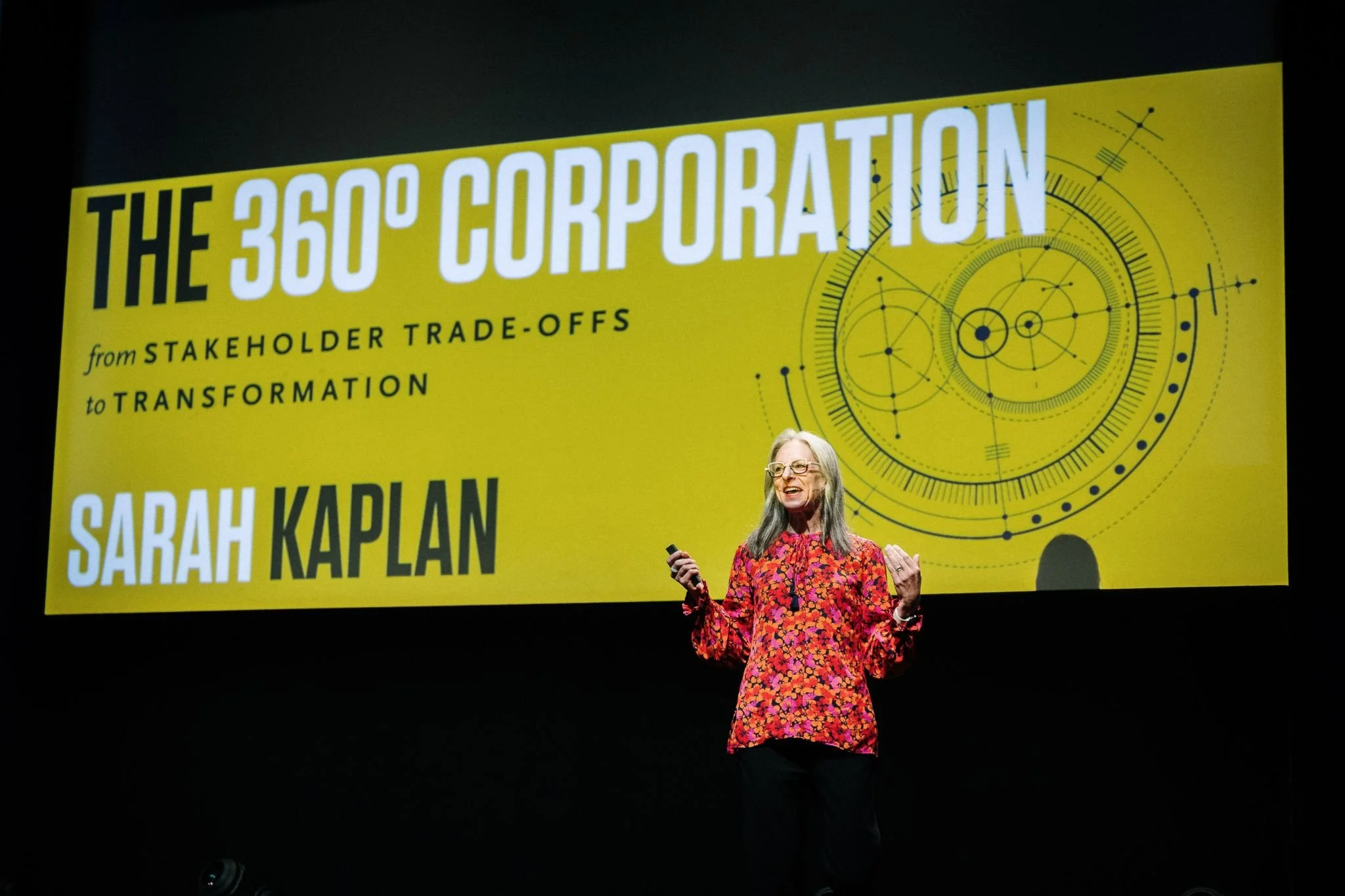
The 360º Corporation
From Stakeholder Trade-offs to Transformation

Despite the recent backlash, companies are still facing intense pressures to address stakeholder demands from every direction: consumers want socially responsible products; employees want meaningful work; investors now screen on environmental, social, and governance criteria; “clicktivists” create social media storms over company missteps. CEOs now realize that their companies must be social as well as commercial actors, but stakeholder pressures often create trade-offs with demands to deliver financial performance to shareholders. How can companies respond while avoiding simple “greenwashing” or “pinkwashing”? This book lays out a roadmap for organizational leaders who have hit the limits of the supposed win-win of shared value to explore how companies can cope with real trade-offs, innovating around them or even thriving within them. Suggesting that the shared-value mindset may actually get in the way of progress, bestselling author Sarah Kaplan shows in The 360° Corporation how trade-offs, rather than being confusing or problematic, can actually be the source of organizational resilience and transformation.
Responsible Research in Management Award
Winner of the Responsible Research in Management Award, sponsored by the Academy of Management Fellows and the Responsible Research in Business and Management (RRBM).
Social Issues in Management Best Ethics Book Award
Finalist of the SIM Best Ethics Book Award, sponsored by the Academy of Management (AOM) – Social Issues in Management section (SIM).
PROSE Award
Finalist of the PROSE Awards: Business, Management & Finance, sponsored by the Professional and Scholarly Publishing Division, Association of American Publishers.
As reviewed in the Financial Times: “Addressing these paradoxes is at the heart of Kaplan’s book, a guide that aims to topple economist Milton Friedman’s dictum that ‘the social responsibility of business is to increase its profits’. Instead, Kaplan urges us ‘to look at the stakeholders that surround companies from all directions, all 360 degrees’, from the workers in a clothes factory to the community exposed to its waste products. Only then, Kaplan argues, will companies be able to consider innovative ways to respond to these seemingly intractable trade-offs.”
Buy from Bookshop.org or Buy from Canadian independent book sellers. Also available on major online booksellers such as Amazon and Indigo/Chapters.
Portuguese Brazilian edition. Italian edition.
-
"If you want to understand the keys to truly great corporations today, read Sarah Kaplan's The 360° Corporation. Based on more than a decade of research and work with the world's most innovative creative companies, Kaplan shows how the key to sustainable and enduring success lies in effectively engaging all stakeholders and managing complex tradeoffs. A must-read for CEOs, directors, executives, and future business leaders."―Richard Florida, author of The Rise of the Creative Class
"There is a burning need for companies to engage with a variety of stakeholders, but doing so is costly and creates thorny tradeoffs. So how do we do it? This profoundly important book provides a fresh perspective on that question. It's a brilliant, indispensable guide for business leaders―and anyone else hoping to shape the role of corporations in society."―András Tilcsik, Canada Research Chair in Strategy, Organizations, and Society, University of Toronto
"Bestselling author and award-winning researcher Sarah Kaplan offers a wise guide for business leaders facing apparently impossible demands and tough choices in their environments today. Rather than simply looking to manage trade-offs or seeking fast win-wins, she reveals how companies can take a more difficult but ultimately transformational path: embracing the tensions to co-create new models with their key stakeholders."―Tanya Menon, co-author of Stop Spending, Start Managing: Strategies to Transform Wasteful Habits
"As business leaders, we evaluate and make trade-offs every day. Kaplan has prepared a cogent guidebook to help turn these events into strategic opportunities to capture value. The 360° Corporation outlines the critical criteria and a process of inquiry needed to make better business decisions, especially in today's ever-changing stakeholder environment."―Dave Stangis, Chief Sustainability Officer and Vice President of Corporate Responsibility, Campbell Soup Company, Entrepreneur-in-Residence and Senior Fellow in Social Innovation at Babson College
"Using organizational realities, this book puts leveraging tradeoffs instead of romanticizing shared values at the center stage of managerial decision-making. The 360° Corporation offers rare insights on how to combine humility, inspiration, and aspiration in business. A must-read for anyone interested in the potential of companies to do more than generate profits."―Johanna Mair, Professor at the Hertie School of Governance, Co-Director of the Global Innovation for Impact Lab, Stanford Center on Philanthropy and Civil Society
"Today, sustainability is on the agenda in every boardroom. Most executives have come around to the idea that corporations need to do more than just maximize profit―but they don't know how. Sarah Kaplan's book provides a clear roadmap to this goal. As she says, there are no simple solutions here; however, she sets out the tensions and trade-offs with clarity and with many fascinating examples. This book is essential for executives and advisors who are looking to take corporate purpose and sustainability seriously."―Julian Birkinshaw, Professor and Deputy Dean, London Business School
"The 360° Corporation does not dodge the question of cost. Rethinking business models and experimenting withinnovation can be hugely expensive―there is no easy way to become a '360°' corporation....But for those keen to try, with Kaplan's detailed guidelines and compelling examples of how companies such as Nike have benefited themselves and stakeholders with this approach, what is left, as she says, is 'a leap of faith.'"―Antonia Cindy, Financial Times
"[This] book achieves the goals it sets out elegantly. For those interested in an overarching, approachable, and engaging overview of corporate social responsibility, and particularly a stakeholder approach, this is a great read. I would highly recommend it to managers and students who are struggling with how to approach managing for stakeholders while keeping an eye on the bottom line."―Jeffrey G. York, Administrative Science Quarterly
See the ideas come to life in my online course
See how all business models create trade-offs that impact stakeholders, and why it is urgent to address environmental and social challenges.
Learn 4 practical modes of action leaders can use: analyzing trade-offs, creating shared value, innovating around trade-offs, & experimentation.
Explore tools for corporate purpose, social responsibility, sustainability, ESG, CSR, ethics, corporate citizenship and stakeholder capitalism.
More on corporate purpose
Why trade-offs can be a real source of innovation and long-term resilience.
-
Why Social Responsibility Produces More Resilient Organizations
In the Sloan Management Review: Companies have more staying power when management decisions consider a diverse range of interests.
-
The upside of trade-offs
In “strategy+business”: The challenge for those who want to consider these diverse stakeholders (and the worry for those who think it’s a bad idea) is that each stakeholder comes to the party with different interests and views about what is of value. When these interests aren’t aligned, corporate leaders are required to make trade-offs. but they can turn stakeholder scrutiny to their advantage.
-
Financial recovery goes hand in hand with social responsibility
In the Toronto Star: The year 2020 has shown us, perhaps more than ever, the truth of the phrase "if you haven't got your health, you haven't got anything." It's as true for companies as it is for ourselves. But, company health is not just financial.
-
Deck Chairs On The Titanic: The Impoverished B-School Response To A Changing World
In Poets and Quants: Our society is in crisis: even before the Covid-19 pandemic, racism was already unleashed around the world, rising seas were already flooding communities, pollution was choking cities, the AI revolution was creating major dislocations as jobs are replaced with virtual robots, progress toward gender equality has been stagnating or reversing. So far, though, business schools — the place where many future leaders are trained — are failing to respond meaningfully.
-
How corporations are stepping up to tackle crises when governments won’t
In the Conversation: Today we’re facing a whole slew of social, economic and environmental crises—gun violence, climate change, gender inequality, job dislocation, food insecurity, plastic pollution and the opioid epidemic. The responses from governments are often inadequate. Indeed, the problems are so complex that no single sector can address these challenges alone. What’s interesting is when corporations are stepping in to fill the void.
-
What it means for businesses to ‘build back better’ after COVID-19
In Fast Company: The health and economic crisis has prompted pro-employee changes at some companies. They should keep them and do even more.